
Window Dressing: How to Choose Between Steel & Aluminum
Why the Palisades is rebuilding Spanish Revival — and why the window package is one of the most important decisions you make.
Windows are the eyes of the home.
I know that sounds cliché, but they're one of the most important features for a proper Spanish home. You can get the plaster wrong, the tile a little off, the roof pitch not quite right, and a Spanish house will still read as a Spanish house. Get the windows wrong and nothing saves it. Not the arches, not the courtyard, not the most beautiful hand-troweled walls in Los Angeles.
The window is the focal point. Everything else is complementary.
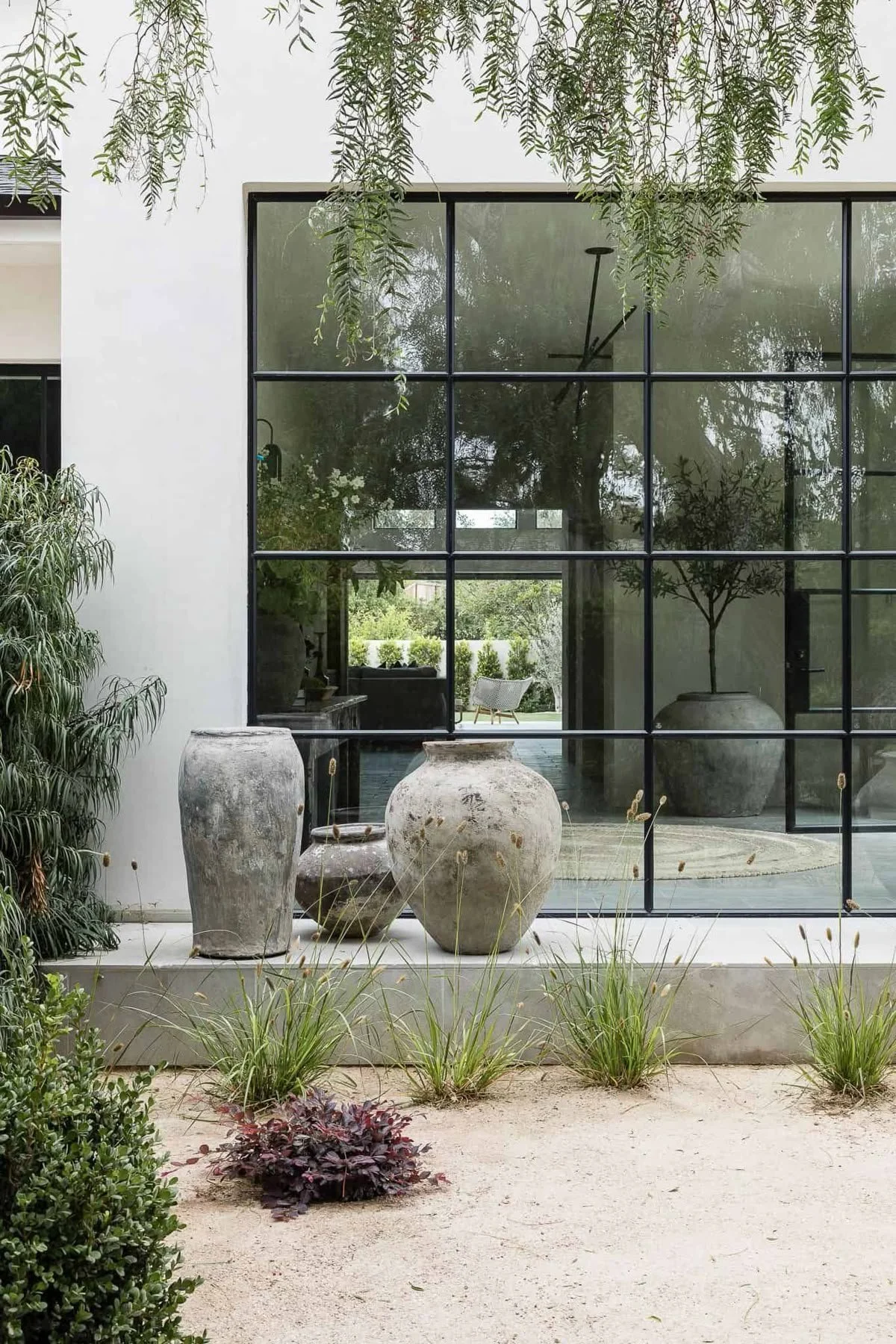
So when a client stands in a framed opening — that rectangle of sky before the glass goes in, my favorite moment on any site — and tells me she wants the house to feel old, I know exactly what she's describing. The black grid. The narrow bar. A frame that looks forged instead of assembled. She's describing a steel window.
And then we have to talk about money.
Why Everyone Is Suddenly Going Spanish
I predicted the opposite. I thought the rebuilds would go contemporary — new construction, clean slate, current code, every incentive pointing toward glass and flat roofs.
I was wrong, and I love being wrong about this.
Almost everything on my desk right now wants to look backward. Tile roofs. Deep-set punched openings. Courtyards. Arched thresholds. Spanish Colonial Revival and Mediterranean, built to 2026 performance. And here's the thing — it isn't nostalgia. There's a rule underneath it, and the rule is older than the fire.
Santa Barbara got flattened by an earthquake in 1925. The city didn't rebuild what it had. It rebuilt something better than what it had, and then made it law. The El Pueblo Viejo Landmark District still requires new construction to follow "the adobe, Spanish Colonial Revival or Mediterranean tradition." A hundred years later. Still holding.
When the 2018 debris flow took 216 homes in Montecito and the County floated relaxing design review to speed things up, the Board of Architectural Review said no. One member put it perfectly: the reinvention of Santa Barbara did not happen by accident.
The Palisades has its own version, and almost nobody knows it. The neighborhood was founded in 1921 as a Methodist Chautauqua — earnest, programmatic, not stylistic at all. But Castellammare was subdivided in 1925 by the Frank Meline Company, on Alphonzo Bell's land, explicitly to look like the Amalfi Coast. Serpentine roads named after Italian towns. Concrete stairs cut into the hillside. And a deed requirement that every single residence be built Italian Renaissance and Mediterranean.
Source: Pacific Palisades Historical Society.
So my clients aren't reaching for a trend. They're remembering an instruction. Somebody told this neighborhood what to look like a century ago, and it turns out the instruction was good.
The Steel Fantasy (And What It Costs)
Real steel windows are gorgeous and the makers are serious. Portella. Hope's. Steelworks Etc. up in Oxnard. Torrance Steel Window Co., whose Los Angeles lineage runs back to 1904 — I love them for restoration work.
The performance case is real, not romantic. Hope's publishes a 1-7/16" sightline on fixed units and 2-3/16" on operable, at a section depth of 1-3/4" to 2-5/16". Steel is stiffer than aluminum, so the profile goes thinner and the glass goes bigger. In a house where the openings are the composition, that's not a spec. That's the entire design.
Now the part nobody puts in a brochure.
In my own bid history, a steel window and door package runs three to four times the aluminum equivalent.
That number is mine — no manufacturer publishes it and I went looking. But it's held across enough of my projects that I now put it on the table in the first budget conversation instead of the fourth. Because I've watched what happens when it shows up in the fourth. On a ground-up house in the $2M+ range, that delta isn't a line item. It's a kitchen. It's a pool. More than once, it's been the difference between building this year and waiting another one.
And the cost is honest — it's hand fabrication, welded corners, galvanizing, thermal break geometry that has to be engineered rather than extruded, and sixteen to nineteen weeks before anything ships. You're buying labor and metallurgy. When it's right, it's so right.
One thing steel will not do: protect your house.
Under CRC §R337.8.2.1 and CBC Chapter 7A, exterior glazing in a Very High Fire Hazard Severity Zone needs to be multipane with at least one tempered lite. The requirement is on the glazing assembly. Not the frame material. Aluminum, steel, and vinyl are all equally permissible. The code does not care what your window is made of.
I say this to every client, because after a fire steel feels like armor, and that feeling is doing a lot of selling that nobody's admitting to. Specify steel because it's beautiful and it lasts. Not because someone let you believe it's protection.
What I Actually Spec
For a lot of my clients, the answer is thermally broken aluminum detailed to read as steel — and I've stopped calling that a compromise. It's a reallocation. That 3–4x delta buys plaster you want to touch, a real tile roof, solid interior doors, millwork that doesn't look like millwork.
Two details do almost all the work, and if you remember nothing else from this, remember these:
One. A beveled SDL bar. SDL means simulated divided lite — a single sheet of glass with bars applied to the face instead of true individual panes. The bevel is a small angled cut along the bar. It has zero structural purpose. Its entire job is to catch light on one edge and throw a shadow on the other, exactly the way a putty-glazed steel muntin did in 1928. It's a manufactured shadow, and I think it's one of the most quietly brilliant details in the industry.
Two. A beveled exterior glazing bead. That's the frame edge holding the glass. Square reads modern. Beveled reads old. This is the detail everyone forgets, and it's the one that gives the game away.
Get both and the illusion holds at ten feet — which, let's be honest, is where people actually stand.
My Three
| Fleetwood | Corona, California |
|---|---|
| Closest to steel | Strong. Publishes a distinct “Steel Look Divided Lite” separate from standard SDL; dealer literature calls it “a classic steel window beveled design.” Bar width not published. |
| Relative price | Highest of the three. Ultra-luxury, architect-driven. Roughly 1.15–1.3x my aluminum baseline. |
| Quality | Excellent. 6063-T6 extrusions, proprietary 316 marine-grade stainless hardware, transferable lifetime warranty. Thermally broken series (the “-T”) run about U-0.19 to U-0.46. |
| Feel | The most substantial in hand. Heavier extrusions, tighter hardware action. It feels like equipment, in the best way. |
| Bronze | Class I Dark Bronze anodized is standard, plus Light and Medium Bronze, custom anodize in five earth tones, 70% Kynar in Statuary and Medium Bronze. |
| Made | Corona, California. One factory, local factory service, fifty-four years. On a rebuild this matters more than it sounds. |
| Watch for | Published lead time 7–9 weeks; LA dealers quote 10–16 in practice, custom finishes up to 24. |
| Weather Shield VUE | Medford, Wisconsin |
|---|---|
| Closest to steel | Strongest on paper. The only one publishing both a 7/8″ Beveled SDL Bar and a Beveled Bead glazing bead as named, separate options. |
| Relative price | Not published; same custom tier. Assume ~1.0–1.15x until a real quote says otherwise. |
| Quality | Excellent. NFRC-verified U-0.17 to 0.49 on direct set, AAMA 2605 paint. Launched 2021, so thin field history in SoCal. |
| Feel | Refined and modular. The frame system joins in nearly any configuration — which matters enormously on a Mediterranean plan full of irregular openings. |
| Bronze | Six anodized finishes including Dark Bronze, sixty paint colors, and two-tone interior/exterior at no upcharge — which is a gift. |
| Made | Medford, Wisconsin. |
| Watch for | Newer product from Weather Shield; there may be some kinks to work out. |
| Western Simulated Steel | Phoenix, Arizona |
|---|---|
| Closest to steel | Purpose-built for exactly this. 0.875″ SDL bar designed to “emulate steel putty glaze,” with beveled glass stops and coped muntin bars. |
| Relative price | Historically the value of the three — ~1.0x. |
| Quality | Good. Insulbar thermal break, minimum DP50, U-0.29–0.30. Ten-year workmanship, lifetime IG. |
| Feel | Lighter. Reads beautifully from across a courtyard. Reads like aluminum with your hand on it. |
| Bronze | Bronze Anodized at Class 1 thickness as standard, not an upcharge. Painted Hillside Bronze is a completely different color. Don’t mix them up. |
| Made | Phoenix. Design studio in Santa Monica, seven miles from the Palisades. |
| Watch for | The line is not in the current catalog — confirm it is still available before you spec it. |
If you want the shortest possible version: Fleetwood for the client who wants the best and is buying local. Weather Shield VUE for the plan with complicated geometry and a two-tone moment. Western for value — if it's still available.
Discounts For Rebuilds
For fire victims, Fleetwood has listed discount programs. You can start an application here:
fleetwoodusa.com/en-us/palisades
Matter Architecture is a Los Angeles architecture and interiors practice working on luxury ground-up residential, rebuilds, complex hillside, and ADUs across the Palisades, Altadena, and greater LA. If you're rebuilding and want to talk — get in touch.